
The concept
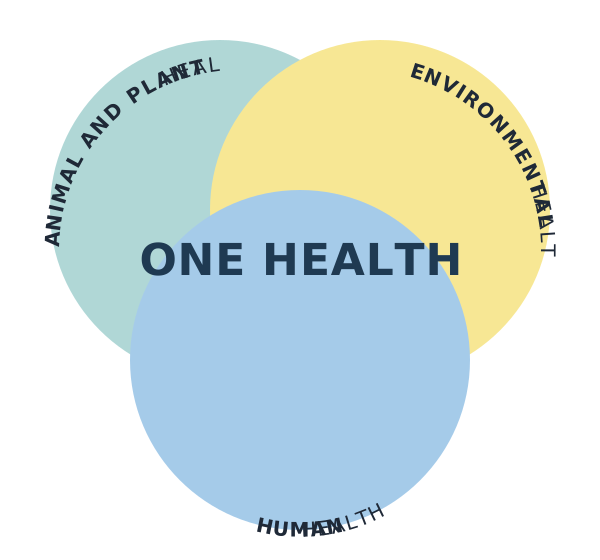
One Health is a framework that recognises a simple but powerful idea: the health of ecosystems, animals, and humans are deeply interconnected. Degrade one, and the others follow.
Deforestation increases human exposure to zoonotic diseases — research has linked recent forest loss to 25 of 27 Ebola outbreak sites, including the 2013 West Africa epidemic that began in a deforested area of Guinea. Meanwhile, pollution is revealing how tightly environmental and health boundaries overlap — in France's "Chemical Valley" near Lyon, over 200,000 residents have been exposed to PFAS, "forever chemicals" now detected in water, soil, and food across more than 23,000 sites in Europe. These are not separate problems. They are facets of the same system.
The concept is not new. It has been championed by the WHO, FAO, and the World Organisation for Animal Health (WOAH) for over a decade. But it has remained largely siloed in public health research. In the corporate and financial sustainability world, "nature risk" still overwhelmingly means biodiversity loss — one leg of a three-legged stool.
The data gaps
Today, anyone trying to assess One Health exposure across a portfolio or supply chain faces three structural gaps:
1. Ecosystem health: increasingly well covered, but siloed.
The science of measuring ecosystem impacts has matured. The IPBES pressure framework is widely recognised. Core metrics are well identified. Life Cycle Assessment (LCA) is established as a key approach to assess value chains, quantifying pressures and using complementary aggregated metrics to navigate between them. The Potentially Disappeared Fraction of species (PDF), for instance, estimates the share of species potentially lost per unit area over time, while other indicators track changes in mean species abundance or absolute species loss. Spatial data layers allow impacts to be placed in their local context. The remaining frontiers — invasive species, marine pressures — are seeing significant progress too.
The ecosystem health pillar is the most advanced of the three. But it remains disconnected from the other two.
2. Human health impacts exist in the data, but are used in different contexts.
The same LCA frameworks that produce biodiversity metrics also produce human health endpoints — expressed in Disability-Adjusted Life Years (DALYs) — a metric that aggregates years of life lost and years lived with disability into a single health burden score, much as ecosystem metrics aggregate species loss into a single biodiversity impact score. Impact World+ v2.1, for instance, provides characterisation factors for 8 midpoint categories: human toxicity (cancer and non-cancer), particulate matter formation, photochemical ozone formation, ionizing radiation, ozone layer depletion, water scarcity, and climate change. These indicators are computed from the same life cycle inventory (LCI) data. They are sitting in the models. They are simply not surfaced.
3. Animal health is almost entirely absent.
Zoonotic spillover risk, antimicrobial resistance prevalence, livestock disease burden — these are tracked by public health agencies (WHO GLASS, WOAH disease notifications, EcoHealth Alliance spillover maps), but they have not been integrated into any corporate sustainability or financial risk platform. There is no standardised way to connect a company's supply chain footprint to animal health outcomes.
The result: the building blocks for a One Health assessment exist — LCA data, spatial layers, health endpoints, public health datasets — but they sit in separate silos. The real gap is not within each pillar. It is between them.
How Darwin changes the equation
Darwin already covers ecosystem health through multiple impact methods (ReCiPe, Impact World+, GLOBIO), spatial risk analysis (30+ indicators mapped to geographies), and site-level assessment. That infrastructure — a quantitative LCA backbone connected to spatial data and risk frameworks — is what makes the integration of human and animal health possible on the same platform.
Human health: already in the pipeline. Darwin is integrating Impact World+ v2.1 human health outputs alongside its existing ecosystem quality indicators. The same LCI data that produces a nature footprint now also produces DALY-based midpoint and damage scores across 8 health categories. No new data collection is required — the characterisation factors are applied to the existing inventory.
This means a company using Darwin can see, for the same product or supplier, both the biodiversity pressure (PDF.m2.yr) and the human health burden (DALY) — broken down by toxicity, particulate matter, water scarcity, and more. The two lenses share the same data, but tell different stories.
Connecting health to risk. Impact metrics alone are not enough. Companies need to know where health-related impacts translate into financial risk. Particulate matter emissions in a region with strict air quality regulation carry transition risk. Human toxicity hotspots near chemical safety enforcement zones create compliance exposure. Water scarcity impacts in regions with water stress compound both operational and reputational risk.
Darwin's risk framework — which already maps nature-related transition and physical risks to geographies — extends naturally to health-related risks by connecting human health midpoints to regulatory frameworks (CSRD ESRS E2 on pollution, EU Zero Pollution Action Plan) and to spatial risk layers.
The path to full One Health. The third pillar — animal health — builds on the same spatial infrastructure. Darwin is already integrating datasets on zoonotic spillover hotspots (EcoHealth Alliance), antimicrobial resistance (WHO GLASS), and livestock disease notifications (WOAH) as proximity flags in site-level analysis — the same approach used for biodiversity-sensitive areas. The causal chain from corporate activity to animal health outcomes is harder to quantify than for ecosystem or human health, but the first layers are being connected now.
The value of integration
What changes when ecosystem, human, and animal health sit on the same platform?
Cross-pillar visibility. A single commodity — say, soy from a deforestation frontier — generates a nature footprint, a human health burden from pesticide toxicity, and a zoonotic spillover exposure. Today, these signals live in different reports, different tools, different teams. Bringing them together changes the business conversation: a sourcing decision that looks acceptable on biodiversity grounds alone may carry unacceptable health liability — or vice versa. One integrated risk profile means better-informed allocation of costs, revenues, and mitigation resources.
Shared data, no duplication. The same life cycle inventory feeds both ecosystem quality and human health endpoints. The same spatial layers that flag biodiversity-sensitive areas can flag zoonotic risk zones. For companies, this means no parallel data collection, no duplicate supplier engagement — one dataset serves multiple disclosure requirements (CSRD, TNFD) and internal risk processes, reducing both cost and implementation time.
Consistent prioritisation. When a company asks "where should we act first?", the answer should reflect all dimensions of risk. A site that scores low on biodiversity risk but high on human toxicity exposure should not fall off the priority list simply because health and nature are assessed in different systems. Integrated prioritisation protects against blind spots — and helps companies allocate limited budgets where the overall risk reduction is greatest, strengthening operational resilience across the board.
Why it matters now
Regulatory pressure is converging on the One Health nexus. The EU Zero Pollution Action Plan targets air, water, and soil pollution with explicit links to human health outcomes. The Corporate Sustainability Reporting Directive (CSRD), through its European Sustainability Reporting Standards (ESRS) E2, requires pollution disclosures that go beyond greenhouse gases. The Taskforce on Nature-related Financial Disclosures (TNFD) framework, while focused on nature, increasingly references the interdependence between ecosystem services and human wellbeing.
For financial institutions, the implications are direct: a portfolio's exposure to nature degradation is also an exposure to human health outcomes — and the regulatory, litigation, and reputational risks that follow. Assessing these dimensions separately understates the real risk.
One Health is not a theoretical concept to aspire to. It is a practical measurement challenge — and the tools to address it are closer than most people think. The foundation is quantitative, multi-method impact assessment connected to spatial data and regulatory context.
This article is Part 1 of a two-part series. Here, we laid out the framework and the data landscape. In Part 2, we will put it into practice — running One Health analyses on real portfolios and supply chains using Darwin, showing what cross-pillar insights look like when ecosystem, human, and animal health data sit side by side.